
Do not be conformed to this world, but be transformed by the renewal of your mind, that by testing you may discern what is the will of God, what is good and acceptable and perfect–Romans 12:2
Mediocrity has come to describe modernity. Even among prestigious institutions, colleges are having to lower entrance requirements in order to reach their quota. It is not necessarily that people are questioning the value of college, though they are, it simply seems that our culture is getting dumber each year. Another manifestation of leaving God out of our educational system.
My own kids have marveled at the eloquence of the writers of history. For example, George Washington wrote his Rules of Civility, which focused on courtesies and etiquette, when he was only fourteen. I know of nobody that age today who could write anything near that mature. Still, George Washington did not think himself to be good at letters.
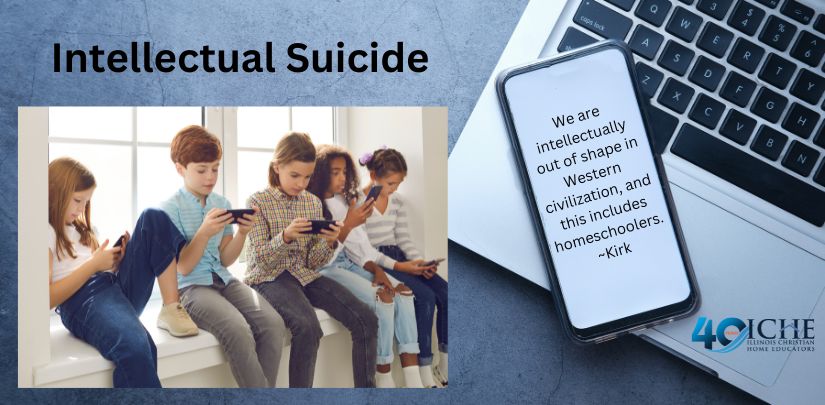
Our culture is committing what I call intellectual suicide. Our young people, as well as many of us older ones, spend too much time watching YouTube clips of mindlessness. These are surpassed by an endless stream of memes from social media. While a proper amount of laughter is medicine for the soul (Proverbs 17:22), Solomon also warned that too much mirth can lead to madness and too much pleasure to uselessness. (Ecc. 2:2) Of course, the culture laughs at such Puritanical cynicism even as they struggle to differentiate a verb from a noun or do basic math.
While there are many culprits in this demise, screen time has to rate towards the top. Through social media our children get to hang out with their digital friends who can be even more disastrous than their physical companions, diving down to the lowest cultural denominator available with every gigabyte. They also have YouTube to rewatch the same movie scene ten times in spite of the fact it had zero worth the first time.
Don’t get me wrong. I want my children to be able to navigate the internet while still living in my home; nevertheless, it can easily go from servant to master. I have shared numerous times that I feel like I let technology into my home a little bit too early. When I say early, my youngest child who got access was around twelve years of age. Still, looking back, I should’ve demonstrated more restraint. Additional children have not helped that trajectory.
Most parents have a good idea that too much screen time is detrimental to their children’s intellectual development. This includes constant technological inputs of text messages, YouTube videos, pictures, or video games, which bombard our brain’s pleasure centers and hyper-stimulates it with dopamine. This overstimulation can make our brain’s pleasure centers less responsive to other more simple, enjoyable experiences, such as eating a meal, reading a book, or having a conversation. Additionally, technology can create structural changes in the brain, which leads to attention problems. Screen time can also negative impact our ability to remember and sleep.*
So what are some alternatives? Always begin in prayer for wisdom. Next, lead by example. If you want your children to have less screen time, you should too. Your children should see you reading, working on projects, enjoying a conversation, etc. This is especially true in the evening, winter hours. Think of healthy alternatives. Our home is beginning to go through a book together with family and a few friends who wanted to join. We are using technology appropriately by having everyone join via video tools. Since most books are written at an eighth-grade level, I intentionally chose a book that will make us read, reread, think, and then reread again. Notes are expected. After all, intellectual laziness often precedes intellectual suicide.
Physical activity could be another alternative. Go bowling as a family, take walks, do a project together like putting together a jig saw puzzle or playing board games. It is not necessarily about accomplishing some great feat; it is about not dummying ourselves down through what we would do otherwise … screen time. Put safeguards in place. This may become radical like everyone turning in their phones at night or have password protection according to the amount of time or the time of day we deem most vulnerable.
Of course, if you have older children in the house, you need to be wise as a serpent but harmless as a dove. Talk to them about what you are seeing. Share your why with them. Ideally, let them make the discovery themselves. Most young adults are pretty honest, if treated with respect and patience.
Let’s get real. We are intellectually out of shape in Western civilization, and this includes homeschoolers. It can be so easy for our children to advance in today’s market, if they would show a little restraint in the screen department. Remember, it is not enough to homeschool. Homeschooling is a mere piece of the pie. We also need to address other areas of life lest we commit intellectual suicide.

-300x147.jpg)